New York City AI School Ban: Nearly six hundred thousand Students Affected by One-Year Moratorium
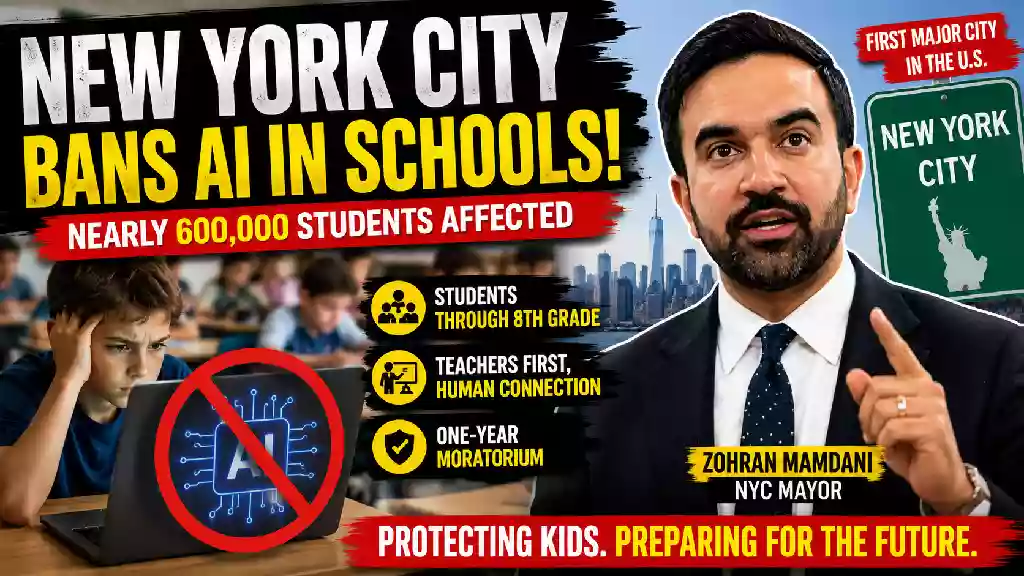
New York City puts AI on pause in schools as a one-year moratorium affects nearly 600,000 students through eighth grade.
New York City AI School Ban: Nearly six hundred thousand Students Affected by One-Year Moratorium
New York City Puts AI on Pause in Schools Affecting Nearly six hundred thousand Students
New York City is taking one of the boldest steps yet in the national debate over artificial intelligence in education, imposing a one-year moratorium on student-facing generative AI for public school students from 2-K through eighth grade.
The policy, announced by Mayor Zohran Mamdani and Schools Chancellor Kamar Samuels, will affect nearly 600,000 students during the 2026-2027 school year. City officials say the move is designed to give educators and policymakers time to evaluate how artificial intelligence should be used in classrooms while protecting students’ ability to develop critical thinking and problem-solving skills.
The decision has quickly become a major national conversation about AI in schools, children’s technology use, education technology and the future of learning.
Why New York City Is Limiting AI in Schools
The policy is based on the idea that young students need meaningful interaction with teachers and classmates rather than becoming overly dependent on technology.
Mamdani has emphasized the importance of human connection, independent problem-solving and allowing children to wrestle with difficult questions themselves. The argument is that education is about more than simply obtaining an answer—it is also about learning how to reason, communicate and develop ideas.
The source material behind the debate similarly emphasizes the importance of students developing critical thinking, mathematics and STEM skills without allowing technology to perform the intellectual work for them.
At the same time, officials are not treating artificial intelligence as something that can simply disappear from society.
AI Is Moving Faster Than Education Policy
One of the biggest challenges facing schools is the speed at which AI technology is developing.
Artificial intelligence has moved rapidly into workplaces, businesses and everyday digital products. Education systems, meanwhile, have struggled to establish rules that protect students while also preparing them for a future in which AI is likely to become increasingly important.
That creates a difficult balancing act.
Schools want children to develop fundamental academic skills independently, but students will eventually need to understand how AI works and how to use it responsibly.
New York’s approach attempts to create space for that discussion before allowing broader student use.
The Debate Over Critical Thinking
Supporters of the moratorium argue that excessive reliance on AI could interfere with the development of independent thinking.
Traditional classroom activities require students to read, write, solve problems, construct arguments and communicate directly with teachers and classmates. Those experiences can help students develop reasoning skills that are difficult to measure through simple answers generated by an AI system.
One parent perspective featured in the original discussion highlighted a school environment that delays screen use while emphasizing literature, poetry, logic and rhetoric.
The philosophy is straightforward: students should learn how to think for themselves before relying on technology to help them think.
Teachers Can Still Use AI in Limited Ways
The AI policy does not mean artificial intelligence is disappearing entirely from New York City schools.
Teachers will still be permitted to use AI for certain instructional planning and operational tasks. That distinction has become an important part of the debate because educators may be able to use AI to reduce administrative burdens without turning over students’ learning to automated systems.
The original discussion also raised concerns about whether teachers should be able to use AI to identify plagiarism and cheating.
One panelist cited a survey showing that 68% of teachers were already using AI to detect plagiarism or cheating. The argument is that artificial intelligence could potentially help educators address problems created or amplified by technology.
What Happens to High School Students?
The restrictions are primarily focused on younger students.
New York City plans to introduce AI literacy education for public high school students, while selected high school programs will be permitted to use certain AI platforms under educator supervision. Companion chatbots, however, remain restricted across grades.
That creates a two-track approach: younger students receive a technology timeout, while older students are taught how to understand and navigate artificial intelligence.
The goal is not necessarily to keep students away from AI forever, but to determine how and when the technology can be introduced responsibly.
New York City Becomes a Test Case
The policy could make New York City an important test case for school districts across the United States.
Los Angeles and other school systems are also grappling with questions surrounding AI, screen time and educational technology. New York’s experience could provide policymakers with information about whether restricting AI improves student learning—or whether students and teachers ultimately need more carefully regulated access to the technology.
The city will also review educational technology and examine how AI affects students during the coming school year.
The Bigger Question: Can Schools Balance AI and Human Learning?
Artificial intelligence is unlikely to disappear from children’s lives simply because schools restrict its use.
Students will encounter AI at home, online and eventually in higher education and the workplace. That makes the central question less about whether children will encounter AI and more about when they should use it, how they should use it and what safeguards should be in place.
New York City’s one-year moratorium represents an attempt to slow down and examine those questions before allowing AI to become even more deeply embedded in classrooms.
For parents, teachers and policymakers around the country, the results could influence how schools approach artificial intelligence for years to come.
#AIInSchools #ArtificialIntelligence #NYCSchools #AIInEducation #EducationTechnology #ZohranMamdani #AILiteracy #K12Education #CriticalThinking #StudentLearning #GenerativeAI